“Passengers pay price in third class while rail bosses enjoy first class gravy train courtesy of their bonuses”

Passengers pay price in third class while rail bosses enjoy first class gravy train courtesy of their bonuses

[from the Yorkshire Post, Thursday 23 August 2018]

As the trains are supposedly a public service, its leaders should be subjected to the standards expected of NHS, education and council supremos.

It’s why The Yorkshire Post was the first newspaper to call for Chris Grayling to resign when the scale of the Transport Secretary’s betrayal of the North, and multiple other failings, became clear.

Yet, while the obfuscating Minister, now universally known as Macavity in these parts, still abdicates responsibility for the summer’s rail chaos because he says he doesn’t run the trains, the case for reform is overwhelming.

In recent weeks, I’ve called for customer service commitments to be the focus of all future rail franchises – and for commissioners to be called in to take over the Northern and First TransPennine Express routes which have been allowed to become a national embarrassment. I also said fare rises should be linked to reliability and punctuality rather than Mr Grayling’s cack-handed plan to penalise hardworking rail staff dealing with the chronic mismanagement of others.

Now I’d go further. I’d introduce a transparency test so the pay and perks of all transport officials earning a basic package in excess of £100,000, whether they be civil servants, the 300-plus HS2 staff already earning six figure sums or executives running the privatised train operators, is published.

The public interest demands nothing less following reports that Leo Goodwin, the managing director of TransPennine Express, received a £36,000 bonus in the last financial year. His total package, which has not been denied, is now said to stand at £360,000 – up on £16,000 on the previous year. It comes after his basic pay rose £10,000 to £275,000 while his bonus rose by £3,000 to £36,000. His pension was also boosted by £3,000.

TransPennine Express refused to answer my questions which offered them a chance to explain the criteria for determining bonuses, how many executives are entitled to them and whether they will be waived.

Like you, I’d love to know if this bonus took into account late-running trains between the North’s main cities? I’m none the wiser. With just 20 per cent of the firm’s services actually running on time, I also asked – on your behalf – when travellers can expect half of trains to arrive within 10 minutes of schedule. Again no answer. Do TPE – or its PR consultancy – understand public relations?

The Department for Transport was similarly unforthcoming. Asked when it knew about Mr Goodwin’s reported bonus, and whether the Government needed more power to intervene over such matters, a spokeswoman said: “Remuneration levels are a matter for individual train companies.” Other questions were referred back to the non-responsive operator. Presumably the DfT just wants the £300m that First Group is due to pay the Government or the right to run the franchise until March 2023 – and doesn’t care about how this is achieved and the human misery being caused.

Yet this is no consolation to passengers, like those in the Pennine communities of Slaithwaite and Marsden, who Mr Goodwin declines to meet in spite of them enduring more than 400 late or cancelled trains in three months. [Note: it’s 500 cancelled, late trains are additional to this figure.]

Meanwhile improvements promised by Mr Goodwin on services to and from Scarborough have not materialised. For the second time this summer, cricket supporters attending Yorkshire’s County Championship match were stumped by late – and cancelled – trains. Some services only got as far as Malton.

With industrialists at Sirius Minerals, North Yorkshire £3.2bn potash mine and one of the North’s biggest private sector investments, going public this week and warning that poor rail services are hindering its work and alienating global investors, the current service to the coast is a betrayal of the pronouncement made by Sir Patrick McLoughlin – the then Transport Secretary – when First Group won the TPE franchise in 2014.

He said the firm “will deliver exciting, ambitious plans that will make a real difference to customers, and – coupled with our commitment to push ahead with electrifying the vital TransPennine route – will help the region realise its full economic potential, ensuring it has a modern 21st century transport system”.

Really? Not only have things got markedly worse, but the promised electrification plan is going backwards and Jake Berry, the Northern Powerhouse Minister, put the onus on the newly-formed Transport for the North when he visited Sirius Minerals this week.

Mr Berry knows TfN still needs the necessary policy and financial powers. Will he deliver them? And will he, and the Government, commit to customer reforms which would stop the first class financial gravy train that Leo Goodwin, and others, have caught at the expense of all those passengers stuck on a third class service because of the rail industry’s mismanagement and weak leadership?

Only those letting down commuters should be fearful of such a transparency test. Yet they’re the ones still at the wheel of this policy wreck. And that’s still the problem.

Link at: https://www.yorkshirepost.co.uk/news/opinion/tom-richmond-passengers-pay-price-in-third-class-while-rail-bosses-enjoy-first-class-gravy-train-courtesy-of-their-bonuses-1-9314737

Posted in Marsden, Slaithwaite, timetable changes, Transpennine Express | Tagged , , , | Leave a comment

“Change needs to come…more quickly than the trains”

“TPEs head of communications says there’s no need for MD Leo Goodwin to meet residents of Marsden and Slaithwaite who have endured hundreds of trains being delayed or cancelled since May, because its staff have good relations with the community.”

Maybe that’s because SMART are rather more polite in our dealings with TPE than passengers would like us to be.

Change needs to come…more quickly than the trains

[from the Yorkshire Post, Saturday 18 August 2018]

If you have already had enough of the delays and disruption on the region’s railways before the insult of next year’s 3.2 per cent fare hike, here’s a depressing prospect.

Unless the Government intervenes, passengers face up to seven more years of mismanagement – and the resulting chaos. It’s because First Group’s TransPennine Express franchise, where a pitiful 22 per cent of trains in Yorkshire now reach their destination within 10 minutes of their scheduled time, is not due to run out until March 2023.

Just one in five TransPennine Express trains are now on time. Of 37 trains to Manchester Airport last Saturday by way of example, two were cancelled, 23 either terminated early or started from the wrong station and another 11 were between 12 and 33 minutes late. I pity the holidaymakers whose travel plans were ruined. A shortage of drivers was blamed nine times – and no conductor in another two instances.

As for Arriva’s Northern service which now regards its Sunday timetable as an optional extra, it’s due to remain in place until March 2025. For, even if the Government reviews, or refines, the franchises, the same old management will stay in place – and be exempt from any cackhanded pay cap that Transport Secretary Chris Grayling tries to impose on front line rail staff.

It’s why the time has come for commissioners to be appointed to oversee these two franchises and their daily operation. This is what happens when council departments hit rock bottom. Yet, while train services are run by private operators, they are still heavily subsidised by the taxpayer and there must be a number of experienced professionals here – or abroad – who could provide the leadership required.

It won’t be easy – I suspect both Northern and TransPennine Express do not have enough drivers to fulfil their timetable obligations – but it’s clear David Brown and Leo Goodwin, the respective managing directors, have lost the confidence of their employees, passengers and all politicians with the notable exception of Chris Grayling (enough said). Change can’t come soon enough – in fact it needs to be quicker than most trains here.

If you think the excuses of Yorkshire’s under-fire rail operators sound familiar, it is because they are.

The promise that TransPennine Express managing director Leo Goodwin made to “restore the level of service customers expect and deserve” – part of a grudging apology for The Yorkshire Post – was picked up by one eagle-eyed reader.

They pointed out that the phrase “expect and deserve” was first used by customer services director Kathryn O’Brien in November 2014. “Everyone in this business is working tirelessly on improvement plans to deliver the service levels you expect and deserve,” she said.

The same again in March 2015. “We have some very focused performance recovery plans that really steer us back into some of the service levels that customers expect and deserve from our business,” she said.

And, in her new role as customer experience director, quite an apt title given the ordeals that have been suffered by many, Ms O’Brien promised this January: “We are continuing to work with industry partners…to deliver the service that customers expect and deserve.”

It’s not the PR script writer that needs changing; it’s the whole franchise. And, to use words familiar to TransPennine Express, it’s what commuters expect and deserve.

When the National Rail Passenger Survey came out earlier this year, 86 per cent of respondents rated TransPennine Express stations as “satisfied or good”.

Yet, when it came to TPE disseminating this, it now emerges that the firm chose to use the word “excellent” in its public documents. In an email, media relations manager Sarah Humphries informed a passenger: “In this instance, we’ve chosen to use the word ‘excellent’ as the word ‘satisfaction’ had already been used within the press release.”

An email sent by an official at watchdog Transport Focus to a passenger, seen by The Yorkshire Post, conceded: “I agree that use of the word ‘excellent’ is not appropriate in this case.”

TPE head of communications Sarah Ford declined to comment – she said this issue was not relevant to the company’s performance. I disagree. The issue is one of trust at a time when most passengers no longer believe TPE’s utterances. She also says there’s no need for MD Leo Goodwin to meet residents of Marsden and Slaithwaite who have endured hundreds of trains being delayed or cancelled since May, because its staff have good relations with the community. Try telling that to those concerned.

Link at: https://www.yorkshirepost.co.uk/news/opinion/tom-richmond-change-needs-to-come-more-quickly-than-the-trains-1-9307774

Posted in fares, Marsden, Northern Rail, Slaithwaite, timetable changes, Transpennine Express | Tagged , , , , , | Leave a comment

Looking to the future – improving the timetable – update

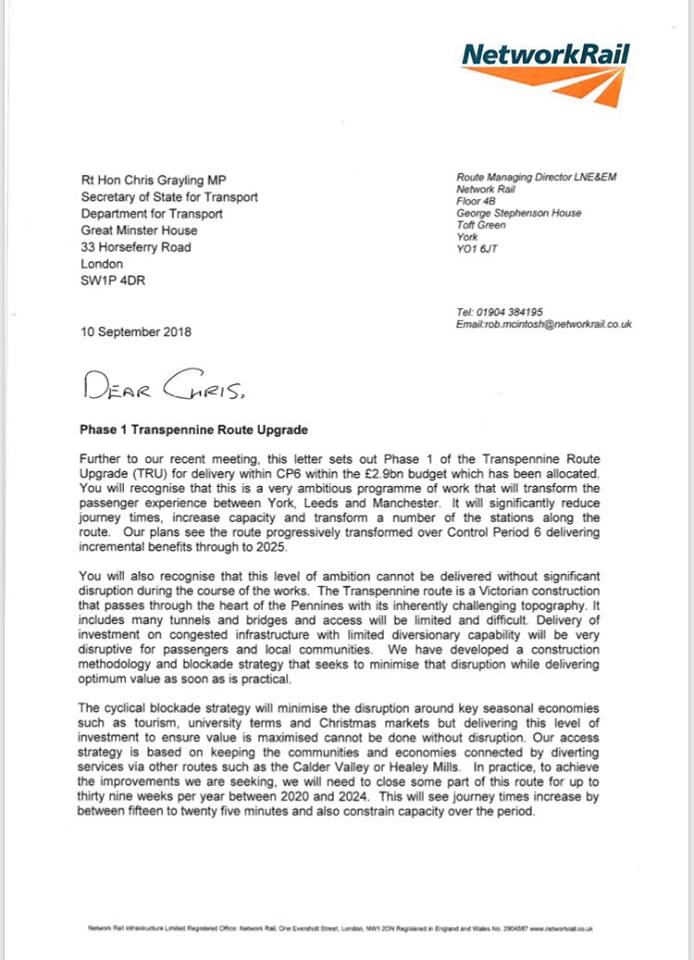
Whilst the focus at the moment is still on the failure to operate a service which resembles the published new timetable , with its large number of cancellations, part-cancellations (as an aside, 21st August saw the total number of cancellations affecting Marsden and Slaithwaite since the timetable change pass the 500 mark) and poor punctuality, there’s still a need to look beyond the day-to-day issues.

SMART’s objective remains a daytime service of two trains per hour, with additional services at peak times. Whilst that may be difficult to achieve before the Transpennine Route Upgrade (whatever that may contain) is carried out, that doesn’t mean that nothing can be done.

Transport for the North (TfN) have recognised the issues with the timetable at Slaithwaite, Marsden, Greenfield and Mossley, and it’s one of the things they are looking at with a view to making changes to provide us with a more coherent and more frequent service.

SMART is one of the stakeholders that TfN have been talking to, and we have made some suggestions as to what changes we would like to see to improve both frequency and reliability.

It’s on the agenda for the TfN Rail North Committee Meeting on 23rd August. Item 4  refers.

TPE North Route Calling Pattern
6.5 Following TPE’s timetable consultation for May 2018, two issues have been raised by stakeholders. These are focused on the North Route, where the intermediate stations between Huddersfield and Stalybridge are covered by ‘skip stop’ operation of the Manchester to Hull train and the Manchester to Leeds stopping service.
6.6 Initial discussions have taken place with regards improvement schemes that could improve the consistency of the calling pattern and reduce the number of calls in the Hull service.
6.7 Rail North Committee is asked to endorse further development of a North Route scheme, with a view to funding improvements through the Service Option Scheme Fund

link is https://transportforthenorth.com/wp-content/uploads/Item-4-Timetable-Development.pdf

Posted in Marsden, Slaithwaite, TfN | Tagged , , | Leave a comment

SMART’s submission to ORR timetabling enquiry

The following was prepared by SMART to feed into Railfuture Yorkshire’s response to the Office of Rail and Road’s timetabling enquiry:


Rail user feedback on timetabling issues

Your organisation: Slaithwaite & Marsden Action on Rail Transport
Train company (delete where not applicable):
·         Northern Rail
·         TransPennine Express


1. What was the quality of the information provided by the train company (on the train, platform, etc before and during the disruption)?

Before commenting on the scale of disruption, information and mitigation, it has to be put into context. Until the timetable change, Slaithwaite and Marsden were served by a basic hourly service calling at all stations between Huddersfield and Manchester Victoria. This was supplemented by additional trains at peak times giving a roughly half-hourly service both to/from Huddersfield and to/from Victoria in the morning and evening weekday peaks. This was provided by Arriva Northern. The quality of the rolling stock, and the standard of internal cleaning was poor, but it was generally sufficiently reliable for passengers to be able to trust it to get them to and from work without significant delay. Performance did, however, deteriorate alarmingly in the four months of so prior to the timetable change.

The May timetable change saw huge changes, with almost all services at Marsden and Slaithwaite being provided by TPE on a skip-stopping basis. Slaithwaite is served by Manchester to Hull trains, and Marsden served by Manchester to Leeds trains, described as semi-fast but stopping at 10 stations between Manchester and Leeds. A further important change was that services would go to and from Piccadilly rather than Victoria, substantially inconveniencing the large majority of commuters whose destination was close to either Victoria or Salford Central. The new timetable also saw a reduction in the peak frequency Slaithwaite/Manchester from half-hourly to hourly, and a lesser but still significant reduction in peak frequency Marsden/Manchester. Improvements, at least in theory, were the introduction of regular through trains to Leeds, along with reduced journey times to both Leeds and Manchester. So commuters were already facing the biggest change in a generation, with trains going to the wrong Manchester station and with the reduction in peak frequency giving less flexibility to passengers.

It is in this context that SMART predicted major problems even on the assumption that the timetable would function as planned.

TPE put considerable time, effort and staff resources into informing passengers before the timetable changes, but the reality of the post-May 20th service has been so different from what was proposed that most of that communication effort has been wasted. The timetable TPE informed passengers about has turned out to be a work of fiction.

The scale of the disruption has been so great that it has been difficult to comment on the quality of information provided, as there have been so many places and occasions when that information has been needed.

We have not attempted to comment on Arriva Northern’s services, as their role in providing services on our route since the timetable change has been very limited.

1a. How was this information communicated, and was it timely?

There are multiple sources of information on the internet, plus passenger information screens and public address at the stations. It is not possible for a rail users’ group to monitor all of these, but we are able to make some comments.

The information systems on the stations have informed passengers of disruption in the form of delays and/or cancellations. They have not, however, provided any information as to what arrangements exist for passengers to undertake their disrupted journeys.

We have looked at journeycheck.com regularly. On occasions where trains have been terminated/started short at Stalybridge, the advice provided has typically advised passengers for stations further afield to catch a later train at Manchester Piccadilly, but provided no information for passengers looking to get to Marsden or Slaithwaite, nor for any passengers looking to board at Marsden or Slaithwaite. If any advice is provided for passengers for Slaithwaite and Marsden, it is generally to wait for the next train an hour later. Sometimes by looking further down on journeycheck.com, it transpires that the train which passengers are directed to an hour later is also cancelled.

It is difficult to describe information as timely when it is of such limited use to passengers.

1b. Do you have any views on how the information might be improved?

The sources of information we have listed under 1a need to provide accurate information as to how passengers to/from Slaithwaite and Marsden can make journeys with as little delay as possible. Sometimes this should involve directing passengers to the next train from Manchester to Huddersfield and then doubling back.

However, there is a limit to how much impact improved information will have, when the real need is for TPE to make arrangements to provide a more reliable service and to provide adequate mitigation at times of disruption.

2. What was the impact of the disruption on passengers?

Disruption has led to

·         extended journey times – sometimes with journeys which ought to take 30’ taking two hours plus,

·         inability of commuters to get to work on time,.

·         Commuters having less time with families because of the need to set off earlier in the morning to be certain of getting to work on time, and returning home later in evenings

·         difficulties in arranging childcare when the morning services are prone to short-notice cancellations and commuters cannot rely on getting home in the evening in time to collect their children.

·         Cancellations leading to overcrowding on the remaining services which have run, partly mitigated by  a reduction in passenger numbers because the service is no longer reliable or trustworthy

·         passengers making their journeys by car instead. Passengers are abandoning a train service which cannot be relied upon

·         businesses in Slaithwaite and Marsden report that it is impacting on them, too.

2a. Did this vary by passenger type?

Passengers who previously relied on the train to get them to work have the (unsatisfactory) option of combinations of buses with greatly extended journey times, but this is less of an option in evenings as bus services are much more limited, or they can drive to their destination. However, for many commuters there is no viable alternative to using the train and they have to set off earlier in the hope that a train will turn up sooner or later. This is made more difficult by the reduction in the number of peak trains under the new timetable, referred to in 1a.

Daytime passengers are more likely either to use other modes of transport or simply not make the journeys they intended.

3. Did the train company take any action to mitigate the effects of the disruption?

So far as we are aware, very little. Before the timetable change TPE were keen to highlight their ability to mitigate disruption, as a consequence of most of the trains being operated by TPE with very few peak weekday trains being operated by Arriva Northern. One of the specific actions identified by TPE (referred to in a public meeting) was the provision of stop orders at times of disruption. This has happened on perhaps four occasions in the eight weeks so far of the new timetable, even though there have regularly been two or three hour gaps in services, and even occasionally four hour gaps. We have met with TPE but they were unwilling or unable to provide an explanation as to why what we were promised has not been done.

On occasions, rather than seeking to mitigate the disruption, TPE have chosen to make the situation worse. Apparently in order to protect other TPE services serving other stations which see several trains per hour, they consider it acceptable and expedient to skip scheduled stops at our stations and run these trains fast between Huddersfield and Stalybridge or Manchester. An example of this was on 18th July, when the eastbound 1115 and 1315 at Slaithwaite were cancelled outright, whilst the 1215 went through without stopping. This created a four-hour gap in what is supposed to be an hourly service.

On very few occasions TPE have provided a replacement bus. This takes more than three times as long as the train, and in Slaithwaite and Marsden the replacement bus stops are on the A62, on the opposite hillside from the railway stations. This does not provide a satisfactory alternative.

One mitigation that TPE have put into place, at our request, has been to allow passengers travelling between Manchester and Slaithwaite/Marsden to double back at Huddersfield at no extra fare at times of disruption. However, they have not publicised this, so most passengers are not aware of it. Only on 17th July have SMART been in a position to inform passengers (something which should be done by the train operating company, not by a rail users’ group), so it is not yet possible to assess what impact this will have.

3a. Were the mitigating actions successful?

No. See above. One of the actions which TPE have regularly taken to try to mitigate disruption elsewhere (to journeys which already see a much more frequent service) is to regularly terminate Hull to Manchester services (which provide the basic hourly service at Slaithwaite and Mossley) and Leeds to Manchester services (which provide the basic hourly service at Marsden and Greenfield) at Stalybridge. Up to 7th August, termination/starting services at Stalybridge has happened on over 200 occasions. This frequently happens at short notice. The reason is that the train has a turnround time at Manchester Piccadilly of just 7 minutes, which does not allow time to cope with delays. The practical effect of this is to leave passengers stranded six miles short of their intended destination, and left to work out for themselves how to complete their journeys. In the return direction passengers at Piccadilly are unable to get to Stalybridge in time to catch their intended train. Sometimes this has happened to consecutive trains, with the effect that a journey of just 20 miles from Manchester to Slaithwaite can take up to 2½ hours.

We have met with TPE and made it clear that in terms of the impact on passengers this is unacceptable and unjustifiable. TPE did not seem to understand that the impact on passengers was relevant. All they were interested in was attempting to get their unworkable timetable plan to work reliably for its core of four fast trains between Manchester, Huddersfield, Leeds and York. They have treated, and continue to treat, passengers at smaller stations in between with contempt.

It is left to passengers to make their own arrangements to mitigate disruption. For many of them this has involved either using their car for the entire journey, or driving to the nearest convenient Metrolink stop at either Derker, Oldham or Ashton. From our observations we estimate that usage of trains between Slaithwaite/Marsden and Manchester is down by about 30%.


Posted in timetable changes, Transpennine Express | Tagged , | Leave a comment