
As part of the Transpennine Route Upgrade (TRU) Network Rail are proposing a number of changes between Standedge and Gledholt (Huddersfield).
This includes upgrades at Marsden and Slaithwaite stations, the reconstruction of various bridges and highways, and the installation of new track, signalling and cabling.
They will also be setting up some temporary construction compounds. They are keen to share these proposals with the local community and hear feedback on their plans.
The works represented in this public consultation do not include the entirety of the activities between Standedge and Gledholt.
Residents and passengers (and anyone else) will be able to view their proposals and share your views by visiting a virtual public consultation room on their website until Friday 24th April.
They will also be holding a third drop-in session for you to see their plans and chat with their project team:
The timings for the first two drop-in sessions were a bit awkward for regular commuters, and when this was pointed out a third drop-in session was promised.
• Saturday 18 April 2026: 10 am – 1 pm Marsden Mechanics, Peel Street, Huddersfield, HD7 6BW. You can get to it using the Rail Replacement Bus Service on that date.
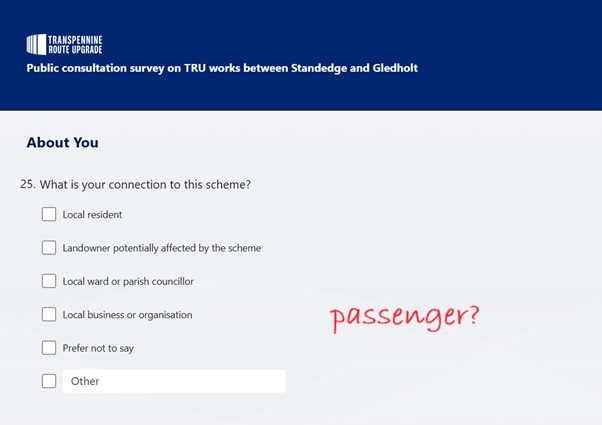
One of our criticisms of the Stalybridge to Diggle consultation was that it appeared to be aimed more at dog walkers than at passengers. Given the list of options, which still does not include “passenger”, it seems this has not been taken on board.
There is much that is positive. Both Marsden and Slaithwaite stations are to be made fully accessible, with a larger car park at Slaithwaite station. A third track is to be provided between Gledholt Tunnel and Marsden, allowing expresses to overtake slower freight and local stopping services.
It has long been known that at some point TRU would result in severe disruption in Marsden and Slaithwaite.
As long ago as 2018, a leaked letter from Rob McIntosh (then Network Rail Route Managing Director, LNE & EM) to the then Secretary of State in 2019, stated that the project
“will be very disruptive to passengers and local communities”, that
“communities such as…….. Marsden and Slaithwaite would be hugely affected as many rail services would have to become bus replacements”,
and
“consulting with all the stakeholders in the region we shall work through the detail of these plans to understand better their implications”.
Clearly “all the stakeholders” did not include passengers at Slaithwaite and Marsden.
Andrew Haines, then Chief Executive of Network Rail gave an interview in the Guardian in 2019, in which with specific reference to the Transpennine Route Upgrade he highlighted the need for Network Rail to consult more with passengers.
It’s only now, in 2026, that some consultation is taking place in our communities.
It is our view that consultation should have started before the first month-long closure, for the remodelling of Stalybridge station, in 2023, and definitely before the month-long Huddersfield station closure in September 2025. It was never reasonable to expect passengers to put up with disruption on that scale whilst being unable or unwilling to discuss what outcomes the project will deliver for communities like ours along the route. Building public support for the project becomes a whole lot easier when residents and passengers can see what outcomes the project will deliver and when.
Saying:
“It’ll be great. We can’t tell you whether your stations will get a more frequent stopping service”
is not the way to secure local support for the project.
However, that’s not the way the railway industry has structured TRU. TRU covered the entire route between Manchester and York (let’s overlook, for the time being, that Manchester to Stalybridge was originally supposed to be the final phase of the North West Electrification Project, due for completion in 2018), and it has been split into several parts, each of which are at different stages of development and progress. Developing the scheme piecemeal may be good for getting approval from HM Treasury, but from the point of view of a resident/passenger who wants to know what the completed scheme will deliver for them and when, it’s not helpful.
As long ago as 2018, we asked the then Secretary of State Chris Grayling whether the completed TRU would deliver two stopping trains per hour throughout the day for Mossley, Greenfield, Marsden and Slaithwaite. He said he didn’t know but would find out and tell us. In the following 7 years neither he, nor any of his successors, nor anyone else from within the railway industry, has been prepared to answer this simple and obvious question. It’s a question SMART will continue to ask for as long as we need to.
From a passenger point of view, the complete package of what works will take place and when and what outcomes the project will deliver are important. Station accessibility is important, and it’s welcome that it will be provided, but if all that achieves is to enable wheelchair users to access the platforms in order to watch other people’s trains whizz through at 85 miles per hour then it’s nowhere near as useful as it could be. Therefore one of the key things we will be emphasising in response to this consultation is the importance of a clear commitment to a more frequent stopping service.
The virtual consultation shows locations which are being considered for site compounds, locations such as bridges where changes will take place, plus the designs for rebuilding Marsden and Slaithwaite stations, which amongst other things will make them fully accessible.
The proposal to make Crimble Bank a one-way street underneath Slaithwaite station is likely to provoke debate, as are some of the suggested locations for site compounds.
Some of the proposed locations for site compounds, in particular those close to Titanic Mill in Linthwaite and Tunnel End in Marsden, are already causing disquiet.
Responses can be provided online or in person at the two drop-in sessions.
SMART will certainly be asking about timescales and sequencing of works, and we will continue to seek a clear and unambiguous commitment to two stopping trains per hour.
The proposals, including two pdfs showing locations of potential site compounds and bridges where work needs to take place, and consultation responses can be given online at
https://standedgetogledholt.consultation.ai
and in person at the drop-in session.