Delay Repay 15

TransPennine Express has announced that from Sunday 02 February 2020, customers who are delayed by 15 minutes or more will be entitled to compensation.The scheme, called Delay Repay 15 (DR15), is a further extension of the current Delay Repay scheme where customers receive compensation when their train is delayed by 30 minutes or more.From 02 February, customers who are delayed by 15 minutes or more will be able to claim back 25% of their ticket price for a single ticket, 12.5% of their ticket price for a return ticket and season ticket holders will also be able to claim compensation should their train be delayed.

https://www.tpexpress.co.uk/media-centre/news/2020/january/transpennine-express-launches-delay-repay-15-for-customers

Posted in compensation, Transpennine Express | Tagged , | Leave a comment

“Northern rail collapse will mean ‘light at end of tunnel’ for commuters here say Cabinet ministers”

[from the Yorkshire Post, Thursday 9th January 2020]

Cabinet Ministers Grant Shapps and Jake Berry says the imminent financial collapse of under-fire rail operator Northern represents “a light at the end of the tunnel” moment for beleaguered commuters.

They used a joint interview with The Yorkshire Post to put TransPennine Express – and other under-performing rail firms – on notice to improve their performance.

And they used the watershed moment to criticise the performance-related bonuses awarded to senior rail executives across the industry when less than half of trains operating in the North are currently on time.

It comes after the latest “financial information” received by Mr Shapps, the Transport Secretary, confirmed that the Arriva-owned Northern franchise “will only be able to continue for a number of months” unless the Government intervenes.

He will now decide by the end of the month whether to award a short-term franchise – the Government is waiting for a review into rail franchises to report – or to nationalise the service by setting up an Operator of Last Resort under DfT control.

“We’ve got this moment of default which is big, but we’ve now got this opportunity to come together and stop blaming each other, and actually deal with the problems,”

Mr Shapps told this newspaper before stressing that day-to-day services, and staff, will be unaffected.

“I’m as impatient as anyone to see this fixed and my actions today are part of that journey.

“The important thing is this is a ‘light at the end of tunnel’ moment. I’ve made clear since I became Transport Secretary, as a long suffering commuter myself, people should be able to turn up, the train should be there, they should be able to get home from work.

“I’ve missed picking up my kids from school before because of this – hugely inefficient services and that has to change. I hope this sends a strong signal across the whole network.”

Mr Berry, the Northern Powerhouse Minister, denied that Theresa May’s government had been too slow to respond. Describing this announcement as “a line in the concrete” and a “big step”, he added:

“Having a company in financial default, having services that more often than not turning up on time, is completely unacceptable.”

But Mr Shapps accepted that Northern was not solely to blame for the current difficulties – Network Rail upgrades delayed the introduction of new trains – and warned that change “won’t be overnight”.

“I think the way the franchise contracts have been written is not up to the task. The system concentrates on financial default, which is the thing that has allowed us to get today. It should concentrate on service default,” he admitted. “If you don’t run trains on time, you don’t run trains.

“I’ve seen stories of people having to give it up jobs because it was becoming impossible to reliably get to work on time reliably – their lives were being fundamentally changed. For me, and it goes beyond Northern, it is quality of service that matters.”

Asking “how can it be right” that rail executives are paid performance bonuses at this time, he said TransPennine Express – owned by First Group – must improve its longer-distance services.

“On TransPennine, I’ve invited in – I think we can say it will be a ‘no coffee’ meeting – TransPennine, Network Rail and the train manufacturing companies to find out what the hell is going on.” he added. “What has happened with Northern will send a clear signal that we’re not prepared to put up with it.”

https://www.yorkshirepost.co.uk/news/politics/northern-rail-collapse-will-mean-light-at-end-of-tunnel-for-commuters-here-say-cabinet-ministers-1-10193036

Posted in Northern Rail, Transpennine Express | Tagged , | Leave a comment

“This is why stripping Northern of its franchise wouldn’t solve Yorkshire’s rail issues”

[from the Yorkshire Post, Friday 3 January 2020]

Delays, cancellations, old trains, staff shortages, strikes and bungled timetable chaos.

Northern has seen it all in the three years since Arriva took over the franchise from previous operators Serco-Abellio, who ran it under the Northern Rail brand.

Now rail industry sources claim that Northern could be stripped of its operating rights as early as March 31 under government plans.

Although the Department for Transport has not confirmed that Northern could cease running trains in the spring of 2020, transport secretary Grant Shapps has admitted that his ministers are considering the feasibility of re-nationalising the Northern network.

The sources have claimed that bringing Northern routes under public ownership would also mean splitting the franchise area into two regions, North West and North East, which would be run independently of each other. However, the DfT said they were still considering other options, such as a fresh short-term agreement with Northern until the franchise could be re-awarded.

But just why has Northern struggled to run an efficient railway? The operator claims that not all of the issues that have beset the region’s commuter and rural services are its own fault – asserting that delays to major infrastructure upgrades, such as electrification, have been the root cause of many of its problems. They say the continued reliance on diesel has had a knock-on effect on performance, causing train shortages and requiring the retention of older stock such as the hated Pacers.

Here we examine the major reasons for the failure of the franchise.

Old trains

The last major renewal of rolling stock used on what are now Northern’s lines was in the 1980s, when British Rail still ran the national network. This is when the Pacers – converted buses intended as a temporary stopgap – were introduced. Now they are only just being retired, and on some routes will continue in service into 2020.

Northern have received some other, newer trains during the past 40 years, but there hasn’t been a mass upgrade of the scale that will now happen when the Pacers are replaced with new stock. The new diesel Class 195s and electric Class 331s were introduced last summer, the first new trains to be put into Northern service since 2000.

The old fleet requires extensive maintenance – breakdowns are common and trains needing repairs pose timetabling issues.

Between 2004 and 2016, the franchise was run by Serco-Abellio (under Northern Rail) on a no-growth contract. This meant that there was no incentive to invest in new trains and revenue beyond a certain threshold had to be returned to the government. It’s thought that this was because the franchise wasn’t expected to succeed – but it actually saw large passenger increases during the Northern Rail period, leading to a strain on resources.

Delays to electrification

Northern attribute the failure of the state to electrify the majority of their network as being a key cause of the franchise’s woes. Essentially, it has left them relying on an ageing diesel fleet during a period where there were fewer new diesels being built.

In 2009, it was predicted that all of the north’s arterial lines would be electrified in 25 years. But work has been well behind schedule, and for many routes has been postponed indefinitely.

This has meant that the Pacers had to stay, as newer electric trains couldn’t serve most of Northern’s network. Northern struggled to lease more diesel units from elsewhere in the UK; during the Tour de France Grand Depart in 2014, when they wished to run extra services for cycling fans, they chartered in spare diesels from other operators but still couldn’t meet demand.

Now, many operators are placing orders for new ‘hybrid’ trains that can run on both wired and non-electrified routes, such as LNER’s Azumas – but for most of the past decade, there was no incentive to invest in diesel.

Former signalman Adrian Caltieri, who is now a tutor at the Institute of Railway Operators, says that the Leeds-Harrogate route was one of the victims of this failure to deliver:

“The late completion (by over two years) of electrification of the Manchester-Bolton-Preston route is the responsibility of Network Rail. This required the continued use of diesel trains which should have been used to strengthen services elsewhere on its non-electrified routes, including Leeds-Harrogate.”

Driver shortages

Staffing has been a constant thorn in the side of both Northern and its predecessors. Driver retention has suffered as freight companies have poached trained staff. Although passenger train drivers often earn more than their counterparts in the freight sector, staffing levels still haven’t fully recovered. Rest day working became common and the industry is now more reliant on overtime to fill rosters. Sunday services have been particularly badly affected.

There have also been high-profile issues with staff sickness. On Christmas Eve, Northern had to cancel numerous trains due to ‘unprecedented’ levels of absence.

Rail planning and operations consultant William Barter explains:

“Historically railways always regarded Sunday as being outside the working week, and an extra day’s work at overtime rates. You can imagine this was quite popular with the staff! But overtime is voluntary, so if someone declares they don’t want to work a particular Sunday you can’t make them, and if everyone declares that, you have a problem.

“Maybe it didn’t matter too much in the days when Sunday services were very sparse and not many staff needed, so that turning down a Sunday was no big deal. Most franchises have now negotiated what used to be known as continental rostering, which covers the whole week as part of the contracted roster, but a few hang on, including a couple in the south, so it is not just a Northern problem.”

Timetable chaos in 2018

The first of Northern’s major timetable revisions occurred in May 2018. It resulted in widespread delays and cancellations, and Northern then announced that they were taking part in an independent inquiry into the fiasco ahead of their next timetable change, which was planned for December of the same year.

An emergency timetable had to be introduced in June, but this didn’t solve all of the issues.

Northern blamed Network Rail and, again, delays to electrification for the issues. They had only informed train operators in January that that electrification of the Blackpool-Preston route wouldn’t be finished until November, but Northern had already completed driver training with the planned electric trains. They had expected to be able to use the new trains by May and were then forced to draft a new timetable that still depended on diesel. Many drivers were not trained to handle the existing rolling stock in time.

The December timetable included only minor changes, and significant alterations weren’t expected until May 2019, when the new rolling stock was expected to have arrived.

In May 2019, some new services were introduced – the Chester to Leeds express under the Northern Connect branding, and an hourly Hull to Scarborough departure which doubled the frequency on the section between Bridlington and Scarborough. But other improvements could not be implemented without having an adverse effect on existing trains.

A month later, the government-managed Operator of Last Resort opened ‘due diligence’ proceedings, reviewing the performance of the franchise.

During the tumultuous spring of 2018, the number of Northern trains arriving on time dropped from 94 to 57 per cent in just two months.

William Barter asserts that the lack of electrification left Northern in an untenable position:

“The timetable issues of May 2018 were of course a disaster. The root problem was that electrification had not been completed, but other franchises’ service improvements were dependent on the diesel rolling stock being released from Northern.

“Frankly, it’s a no-brainer that if you haven’t got the railway, you can’t run the service, so the only possible solution would have been to postpone the whole timetable change, including the various improvements elsewhere. This would have need someone somewhere, which can only be the DfT, to compensate the operators who would not be able to implement their changes. It’s not the sort of thing the various industry players could agree on themselves by ‘collaboration’, as it’s not a case compromise, but clear losers with no benefit.”

Adrian Caltieri adds:

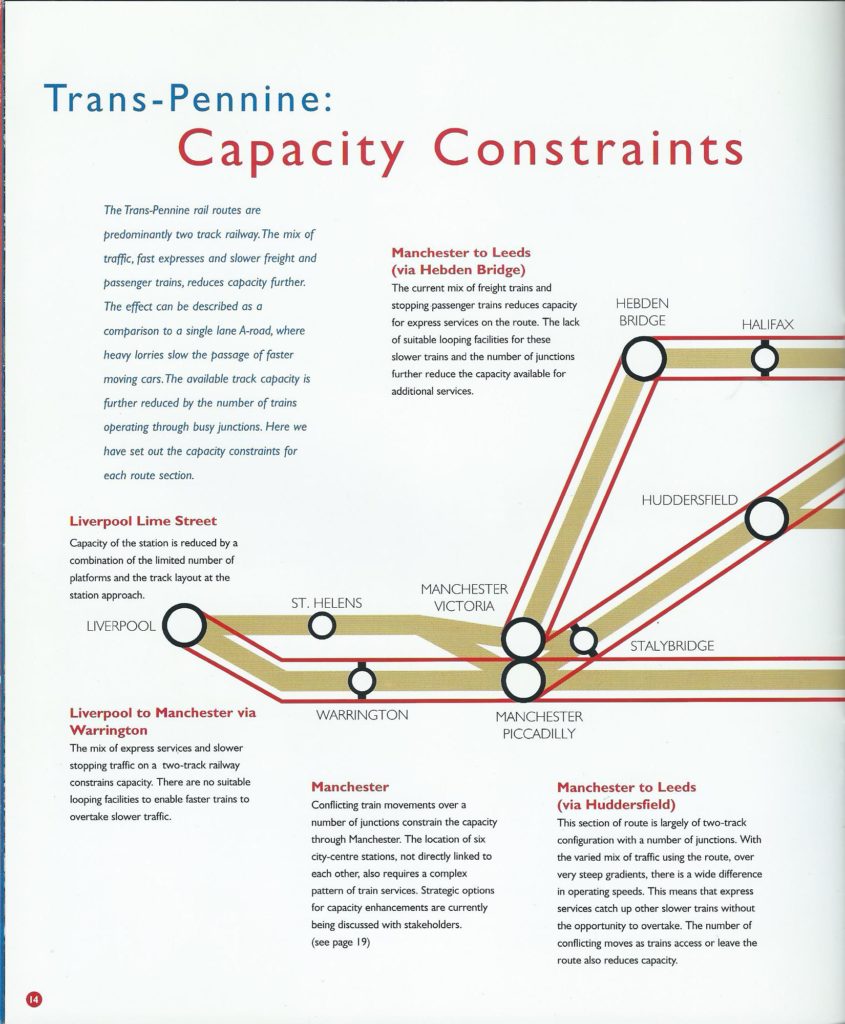
“The timetable on the Liverpool-Manchester-Leeds-York-Newcastle-Edinburgh route has too many trains for the infrastructure to deliver reliably. The mix of stopping and fast services on this route with very limited overtaking possibilities results in any late running by one train impacting on many others. This then affects Northern services around Leeds and York.”

Strikes

Northern has been crippled by industrial action and an impasse in relations between the company and the RMT union, which represents rail staff.

The dispute originated over the role of train guards, which Northern could potentially make redundant as changes in technology reduce their necessity.

DfT targets are for half of future services to be controlled only by the driver, with no need for a conductor to be on board. The guards currently open the doors and ensure passenger safety.

Things came to a head at the end of 2018, when the RMT offered to suspend planned strikes in return for a guarantee that guards would remain, but on November 30 decided to continue with the walkouts.

The saga did not come to an end until February 2019. By this point, strikes had taken place every Saturday since late August 2018. The RMT are now satisfied that guards will be protected under the current franchise agreement.

“The ongoing dispute over driver controlled operation is basically one of maintaining industrial strength,” says Adrian Caltieri.

East v West

Before franchises were re-organised in 2004, Northern’s present-day network was actually two completely separate franchises. First North Western were the last company to run North West Regional Railways, and Arriva Trains Northern ran Regional Railways North East. Manchester was essentially the dividing line between the two. The post-2000 organisation placed the express inter-city services into a Transpennine franchise and the rural and commuter lines into a Northern one – initially awarded to Serco-Abellio.

However, the historic divide between east and west has created a legacy of problems that still exist today. Many long-serving drivers and staff transferred over to Northern Rail in 2004 and remain with Northern today, but their pay and working conditions have been inherited from their previous employers.

Under a legacy trade union agreement, ‘west’ drivers – who used to work for First North Western – aren’t required to work Sundays, but those in the ‘east’ area are. This is why many of Northern’s services running in and out of Manchester are cancelled on Sundays.

William Barter doesn’t believe splitting the franchise once again would lead to an improved service.

“As I recall, Northern was created as one franchise because cross-boundary services were felt to be at risk or overlooked when there were NW and NE franchises. So splitting it up would just reintroduce those problems.

“When the Northern franchise was created, its two components had different staff agreements, and these were never revised as inevitably there would have been a ‘levelling up’ and thus a cost.”

An ambitious blueprint

“It’s a complicated network with many varied and nuanced problems. Part of the problem comes from the deal that Arriva and the DfT both signed. The DfT accepted a deal that was too good to be true and was always going to be very difficult to deliver,” says rail journalist and writer Philip Haigh.

“The DfT asked for half of the services to become driver-only, but Arriva said they would aim for 100 per cent under the new method, which was the cause of the strikes. That was a laudable ambition but never realistic – it would be like writing 5,000 words in 30 minutes.

“Another more subtle aspect is that the bid was put together by Arriva and then handed to Northern staff to implement – the staff had transferred over from the previous franchise and had to make someone else’s plan work. They were aghast and the MD, Alex Hynes, left soon after. He might have stayed if it had been deliverable.

“Northern need to take their share of the criticism as they put forward a hugely optimistic plan. However, the new trains have been late to arrive from the manufacturer and the May 2018 meltdown was caused by late electrification, which had a ripple effect.”

Adrian Caltieri concurs:

“There is a lack of understanding from the public that the government controls investment and also most train fares.

“Having said that, Northern could definitely have managed customer relations, expectations and its reputation in a far better way.”

What happens next?

There are three main options: nationalisation under the Operator of Last Resort, an interim agreement with Northern, or eventual re-tendering of the franchise. In future, it’s possible that the franchise system may be scrapped completely.

“If the franchise did end up being nationalised, the DfT might be willing to make some tough decisions that they didn’t permit Northern to make. From talking to LNER senior managers since the government took them over, they say the DfT now treats them as ‘one of us’ rather than the ‘enemy’,” says Philip Haigh.

“They won’t allow Northern to make key changes to the timetable in the Manchester region, where there are more trains than the lines can cope with. There would need to be cuts to the timetable but this would have a knock-on effect in Yorkshire. Arriva would feel aggrieved if their ideas that the DfT had rejected were then implemented.

“I’m not sure about another east-west split – what would it solve? You would end up with two people on an MD’s salary and two head offices, it would not be efficient. People inside the company would be worrying about their jobs and they would start looking inwards and being more concerned about themselves rather than passengers.

“Whoever takes on the franchise next needs to lay out a very clear plan for how they can improve the situation. They need to be very public about it and take passengers with them. They need to convince them with openness and honesty – that can go a long way. Passengers are hugely upset about overcrowding and cancellations and that is magnified because there is no sense that things will ever get better.

“It bewilders me why anyone would bid for a franchise at the moment – there are no successful ones. If Arriva are allowed to keep Northern under a different arrangement, that to me would say that the DfT are accepting some responsibility for the situation.

“My money is on an Office for Last Resort takeover, which would imply that the DfT is blaming Arriva.

“There is a big review of the franchising system going on at the moment and the model is up in the air – it may not even continue. If not, the alternatives would be nationalisation or the concession model. This would mean that local councils would run local lines on a system of tight control. All the money earned would go back to the government or the councils, and the operator is paid a fee to run a service.

“This could see metro mayor areas like Manchester take over trains and could trigger the east-west split again. But politicians across the north still bicker and want to run their own little empires! The network doesn’t always lend itself to that.”

https://www.yorkshirepost.co.uk/news/people/this-is-why-stripping-northern-of-its-franchise-wouldn-t-solve-yorkshire-s-rail-issues-1-10182110

Posted in Northern Rail | Tagged | Leave a comment

TransPennine Express to refund 2020 fare increase for season ticket holders

[press release from TPE, 6th January, follows]

TransPennine Express has today, 06 January 2020, announced a customer compensation scheme that cancels out the annual regulated fare increase for season ticket holders. 

On 13 January 2020 we will launch for customers of TransPennine Express our Season Ticket Compensation scheme as an apology for the recent disruption across our network. This compensation will cancel the 2.8% regulated fare increase this year for eligible Season Ticket holders.

TransPennine Express customers who held a weekly, monthly or annual rail season ticket between 01 October and 31 December 2019 will be eligible for a 3% rebate of the annualised cost of their season ticket, more than covering the 2.8% average increase on regulated fares.

The compensation scheme will go live on Monday 13 January until Saturday 29 February 2020 – further information is available via the following link on our website:
https://www.tpexpress.co.uk/travel-updates/seasonticket-compensation

This compensation can be claimed in addition to claims made via our Delay Repay scheme, which entitles all season and non-season ticket holders to receive a refund for journeys delayed for 30 minutes or more.

Posted in fares, Transpennine Express | Tagged , | Leave a comment